# Free migrations and buyouts: the SaaS switching pitch
> SaaS rivals are offering migration help, contract buyouts and workflow rebuilds. Our market report examines the changing offers and the work left to customers.
A customer can want to leave your competitor and still renew.
The contract has months left. Years of customer conversations sit in the old account. Someone has to rebuild the workflows, move the data and make sure the next invoice goes out correctly. The team that would handle all this already has a full week.
Free migrations and contract buyouts target that gap between wanting to switch and being able to. Vendors in this report offer to bring the history across, rebuild the setup or absorb some of the overlap cost. For a buyer, those details can matter as much as the feature comparison.
Over the last 90 days, Competitor Tracker & Co. reviewed **66,366 website changes across 2,477 companies and products**. We compared earlier and later versions of migration pages, comparison pages, pricing and documentation, then checked the offers against current instructions and terms.
Some changes add migration capabilities. Others bring an existing service into the sales pitch or explain its limits more clearly. The distinction matters when comparing what vendors promise with what a customer can actually move.
The examples fall into six connected groups:
- **More than the contact list:** keep conversations, records and accumulated history.
- **The vendor takes on the migration work:** include implementation alongside the subscription.
- **The contract you have already paid for:** address the cost of running two products at once.
- **Keeping payments, history and service running:** move without asking every customer to start again.
- **Rebuilding the working system:** recreate rules, permissions and integrations.
- **What the switch still leaves with the customer:** specify the gaps, fees and manual work.
A final question follows: how easy will it be to leave the next vendor?
## 1. More than the contact list
A customer list is only part of what a business has accumulated in its software. A support conversation can include private discussion about how to handle an account. A feedback board contains votes and decisions. A knowledge base has links that customers and search engines already use.
Several vendors now name those details in the migration offer. That gives a prospect something more concrete to compare than an import checkbox.
| Company | Earlier offer | Later offer and current scope |
| --- | --- | --- |
| HighLevel | The HubSpot comparison did not include the detailed importer section. | Adds a named HubSpot importer covering contacts, companies, deals, custom fields, tasks, notes and email history, plus a completed/failed-record report. Current instructions qualify object relationships, recurring tasks and calculated fields; imported email history is read-only. |
| Missive | The Front comparison lacked the later step-by-step switching section. | Adds a sequence for running both products, connecting email accounts and moving the team before requesting the Front export. Full email-history synchronization requires a paid plan. Front comments and Front-only emails are imported from the export. |
| [Frill](/companies/frill/) | Promoted an existing Canny importer. | Expands the public source list to CSV importers for Canny, Aha, Upvoty, Fider and Azure DevOps, naming ideas, votes and statuses. CSV preparation remains part of the work. |
| HelpDocs | Described migration tools more generally. | Makes a migrator suite on every plan explicit. Content and categories can move while the source help center stays unchanged. Some AI-assisted paths consume credits, so inclusion of the suite does not make every operation free. |
| [ProductLift](/companies/productlift/) | Knowledge-base copy lacked the later source-intake and redirect detail. | Adds ZIP or source-URL intake from WordPress knowledge-base plugins, Help Scout, Notion exports and Confluence, alongside redirect tools. Redirects address access through old links; search rankings are outside the stated promise. |
| Plain | Migration sources appeared within changing integration listings. | A dedicated migration hub distinguishes four one-click routes—Zendesk, Freshdesk, Intercom and Help Scout—from five custom-API routes: Salesforce, Pylon, HubSpot, Jira Service and Front. The source determines which route applies. |
| [Circleback](/companies/circleback/) | Earlier release content lacked the new meeting-import announcement. | The August 28 release introduces imports of notes, transcripts, attendees and available recordings from other meeting apps. Imported meetings can be searched, shared and used in questions. A September 9 release adds an API import route. |
| Zoom | Its Slack comparison already linked to migration tools and partners. | Adds more direct switching copy while promoting Chat as included in Zoom Workplace. Current migration guidance offers self-managed Slack transfer, help with other apps and a full-service partner route. The importer predates the rewrite; partner work is separate from subscription inclusion. |
| BigCommerce | The migration app existed before the period examined. | Gives the app greater prominence in its switching material. It transfers products, customers and orders, reports errors and specifies a limit of 500,000 total records across those types. This is promotion of an existing capability. |
| Numeral | The exemption-certificate page lacked the later bulk-transfer wording. | Adds uploads from existing certificate-management providers while retaining mappings to supported integrations. It describes tens of thousands of customers and documents at a time, rather than an unlimited or universally compatible transfer. |
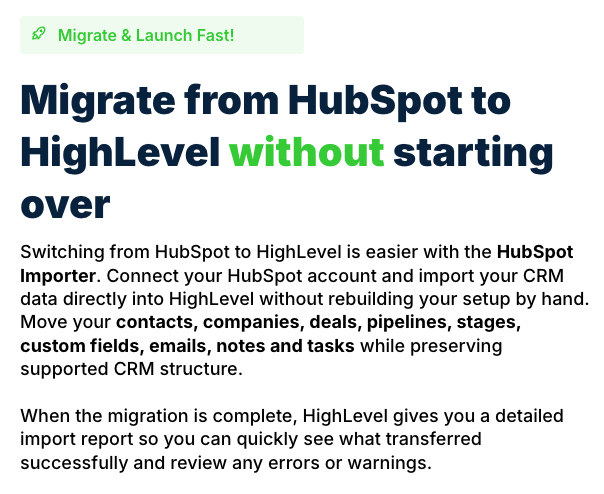
*HighLevel’s HubSpot comparison, captured September 14, 2026.*
The distinction is visible in Missive’s instructions. Email synchronization can retrieve a customer’s message from the mail provider. The private discussion about that message may live only in Front. Naming both tells the buyer which parts of the team’s working memory can come along.
An earlier customer account published by Missive puts that work in context. AGIS Business Travel, a 40-person agency, liked Front but wanted to reduce costs after becoming independent again. Its operations lead spent one to two months testing Missive before bringing colleagues into the evaluation. A simultaneous domain change added forwarding problems. The agency ultimately retained two years of searchable email history and reported about 40% lower spending.
That switch was described around January 2026, before the recent comparison-page change. The account explains the implementation problem; it does not establish that the rewritten page produced the sale.
Meeting assistants introduce another form of accumulated value. Circleback’s import makes earlier meetings available to search and questions inside the replacement. The new tool becomes useful for conversations that happened before the customer signed up.
## 2. The vendor takes on the migration work
The next group addresses who will do the work. Mapping records, checking historical balances, reconstructing settings and training a team take time even when an import tool exists.
The offers range from free team assistance to paid implementation. Several pages now name the people and tasks involved, making the project easier to evaluate alongside the product.
| Company | Earlier offer | Later offer and current scope |
| --- | --- | --- |
| Richpanel | Its migration page emphasized a paid pilot. | Develops separate routes: a two-week free trial for teams under 30 agents and an approximately eight-week goal-based pilot for larger teams. Later copy explicitly assigns migration to Richpanel’s team, with the old helpdesk continuing until approval. The linked guarantee has narrower remedies than the broad marketing language. |
| [Xero](/companies/xero/) | The US payroll page led with Gusto integration. | Presents Xero Payroll powered by Gusto, adding free assisted transfer on request, expert validation of historical data and a QuickBooks Payroll/ADP switching answer. The free transfer applies to this US payroll offer; the ongoing payroll subscription is paid. |
| HelpDesk | Its browser-based helpdesk page lacked the later self-hosted switching section. | Adds free team-supported migration of data, history and workflows from self-hosted systems. Source compatibility and feature coverage still need confirmation. |
| Reckon | Its migration FAQ listed Plus and Premium paid subscriptions. | Adds Ultimate eligibility and Ultimate-specific inventory wording. A more explicit general tooltip states one historical year plus year-to-date data at no extra cost for eligible paid plans. Those time and paid-plan limits already existed in the operative FAQ; other records and later edits can be excluded. |
| LearnWorlds | A premium migration service was already described in the pricing FAQ. | Makes done-for-you migration and named competing course tools more prominent. Current guidance describes a paid service covering content, settings, users, enrollments and progress. A free consultation is separate from the migration fee. |
| [Moorepay](/companies/moorepay/) | Pricing advertised its Simple Switch Guarantee: implementation on the promised date or money back. | Removes the guarantee from pricing while retaining it on the payroll-outsourcing page. The operative remedy is account credit for selected implementations. The guarantee remains published on the outsourcing page. |
Richpanel’s detailed guides separate moving records from configuring the replacement. Its Gorgias migration guide describes API transfer of conversations, contacts, tags and macros, while Gorgias Rules and AI Agent flows require reconfiguration. The Zendesk guide describes sample testing, automation and integration work before channels are moved.
That helps explain the trial and pilot split. Testing an inbox with existing conversations is a different undertaking from replacing a large team’s routing, service-level rules and training. Import completion and approval to turn off the old helpdesk are separate milestones.
The financial guarantee also needs its own reading. Richpanel’s linked terms limit the performance remedy to initial 30-day subscription fees and exclude setup, professional services and other charges. An implementation offer can be substantial without covering every cost of an unsuccessful project.
Across these examples, migration labor is becoming easier to see in the commercial offer. Its price and eligibility still vary. Free assistance on request, a qualifying paid plan and separately purchased implementation each make a different promise.
## 3. The contract you have already paid for
An annual contract creates a reason to wait. A company considering another product can still owe its existing vendor for months. Paying the replacement immediately would add a second subscription during the overlap.
Some vendors now tie incentives directly to that remaining term. That makes the offer more specific than a general introductory discount.
| Company | Earlier offer | Later offer and current scope |
| --- | --- | --- |
| Fathom | Pricing included the label “Competitor migration.” | Makes the Gong offer explicit: migration plus Fathom Business free through the remaining Gong contract. Current wording promises free assisted migration and no Fathom cost until that term ends. The waiver covers Fathom’s fees; the old contract remains separate. |
| UserGuiding | Pricing lacked the later remaining-contract answer. | Adds free use until the existing competitor contract expires, with help moving and testing onboarding content. The examined FAQ states no maximum term. The customer’s original contract remains a separate obligation. |
| Zoho CRM | The homepage lacked the later switching promotion. | Adds a rival-switching offer. The applicable US terms provide free Zoho CRM through the remaining old contract, up to six months, conditional on a one-year contract paid upfront. The offer includes migration assistance and is not six free months for every account. |
| Leapsome | Its migration offer named December 2026 as the maximum overlap endpoint. | Changes the promoted endpoint to March 2027. At review, current banners show March while body/FAQ wording still shows December. The inconsistency prevents treating March as an unqualified promise to every buyer. |
| Default | Earlier material already promoted its legacy-contract buyout fund. | The prominent banner changes or disappears while the dedicated $1.5 million aggregate fund page remains live. It targets routing, scheduling and enrichment contracts through a sales-confirmed offer. The older baseline prevents dating the fund’s launch to this period. |
| Workvivo | The older baseline lacks the later Seer buyout FAQ. | A product-specific offer addresses mid-contract employee-listening customers through sales. Its terms are not fully public, and the longer baseline means it belongs as supporting context rather than a dated recent launch. |

*Fathom’s Gong comparison FAQ, captured September 15, 2026.*
The Fathom offer for Gong customers and Zoho’s switching terms address the same timing problem with their own commercial conditions. One waives the replacement’s fees through the existing term. The other caps the overlap and requires a new annual commitment upfront.
“Buyout” deserves care because vendors use different mechanisms. A vendor can waive its own charges, offer a credit or agree to cover an incumbent bill. A waiver of the new subscription still leaves the old bill to pay. A payment toward that old bill is a different arrangement.
The competitive change is the explicit link to the product being replaced. The remaining term, named incumbent and transfer assistance become part of the pitch. The public page gives sales teams more to discuss than the replacement’s monthly rate.
## 4. Keeping payments, history and service running
A business changing software does not want to make every subscriber, donor or caller participate in the project. A payment method must still work. An existing phone number must still receive calls. A support team needs to keep answering while records move.
These offers describe continuity through the change. They also expose dependencies that ordinary data imports do not solve.
| Company | Earlier offer | Later offer and current scope |
| --- | --- | --- |
| Hyperline | Its billing product page lacked the later migration section. | Adds engineer-led migration from Chargebee, Stripe Billing and Maxio, with a checklist covering a dry run, reconciliation, production transfer, go-live and a follow-up check. The checklist illustrates the offered process; it is not a measured customer result. |
| Paystand | Migration wording described invoice, customer and payment-method data. | Adds explicit vault-to-vault payment-token transfer. Stored credentials are the focus; compatibility still depends on the source processor. |
| Subi | Comparison and migration material gave less explicit source/tool detail. | Names source subscription apps and specialist-run migration. Documentation excludes Authorize.net card transfers, and sources conflict on handling failed payment-token transfers. Some subscribers may need to provide payment details again. |
| SubscriptionFlow | Managed migration was already offered. | Expands the stated scope to subscribers, active plans, payment tokens, invoice history, discounts and trials, with billing continuing through the switch. This is a fuller continuity promise for an existing service. |
| DonorDock | Its recurring-donation migration workflow already existed. | Makes migration more prominent in navigation. The linked process includes record mapping, duplicate checks and supported recurring-gift transfers through Stripe. The newer link promotes the existing capability. |
| Quo, formerly OpenPhone | Promoted number management more generally. | Adds a clearer provider-handled porting process, paperwork assistance and fee language. Call/SMS history does not transfer. Texting registration must be repeated and approval can delay messaging. An FAQ warns about possible old-provider charges despite the broad fee claim. |
| [Omnisend](/companies/omnisend/) | Assisted Klaviyo migration already appeared in its material. | Gives the service greater prominence and offers a demonstration using the prospect’s current setup and invoice. Historical campaign and revenue reports may require separate exports; stated savings and timing remain vendor claims. |
Hyperline makes the business risk especially clear. Its detailed Chargebee migration guide describes checking the next invoice’s amount, currency, date and tax, and separates subscription records from payment methods and mandates. Successfully importing a file does not establish that the next collection will be correct.
The payment examples involve information a customer cannot always export in an ordinary spreadsheet. A payment token represents stored credentials inside a payment system. Transferring those credentials depends on the providers involved. Subi’s Authorize.net exception belongs beside the offer because it changes whether subscribers need to take action.
Number porting has a similar distinction. Keeping the number preserves the address customers use to reach the business. It does not carry the old conversation archive or messaging registration with it. Quo’s documentation separates those jobs even where its sales copy compresses them into an easy-switch promise.
## 5. Rebuilding the working system
Some of the hardest things to replace are the rules a team has built around its software. A report includes calculations and permissions. A commerce setup connects orders, channels and integrations. An authentication system determines who can sign in and whether existing sessions survive.
This group describes converting or reconstructing that operating setup. Automation is part of several pitches, but validation and staged rollout remain visible in the work.
| Company | Earlier offer | Later offer and current scope |
| --- | --- | --- |
| Prophecy | Enterprise Express already included unlimited Alteryx/Informatica workflow imports and time-bounded engineering help. | Sharpens the Alteryx-replacement pitch around migration. Pricing removes a 90-day numeral from one description, while the replacement page still specifies engineering support for the first 90 days. Neither unlimited imports nor unlimited assistance can be called newly introduced from those edits. |
| GoodData | Described the offer as BI Modernization. | Recasts it as AI Migration, with audit/export, logic conversion and phased rollout. The advertised automation percentage is a vendor claim; source compatibility, human validation and parallel running remain part of the process. |
| Vendure | Offered a separately described migration package. | Moves its service proposition toward paid embedded work, while describing channel-by-channel migration with the old commerce system still operating. Migration help continues under the revised service packaging. |
| Microsoft Sentinel | Already promoted migration from Splunk. | Makes AI-assisted conversion from Splunk/QRadar and the safeguards more explicit: analysis first, followed by execution controlled by the customer. The scope is Sentinel security operations. |
| Clerk | Its quickstart instructions could proceed into initialization without the later existing-authentication check. | Adds instructions for an AI coding agent to stop and propose a migration plan when authentication already exists. The change adds a planning safeguard around replacing existing identity infrastructure. |
| ComplyJet | Promoted one-click API migration in minutes. | Replaces that precise speed claim with a team-led offer involving audit coordination and migration through the API. It names responsibility for the project while becoming less specific about how quickly it finishes. |
An earlier Omni-hosted customer account about Cribl illustrates the work behind a reporting-system migration. Four analytics team members rebuilt roughly 100 reports in five weeks. More than 70 power users helped validate content and workflows before the old tool was turned off. The account describes a three-month rollout overall.
The story was published in January 2026 and does not name the incumbent. It is useful here because it separates rebuilding the content from getting people ready to rely on it.
That distinction runs through the newer offers. Logic conversion, review, parallel operation and final switch-over are different stages. A claim about automating one stage should not be read as a promise to automate the whole replacement project.
## 6. What the switch still leaves with the customer
A more specific offer can also reveal more work for the buyer. Some pages replace broad promises with self-service instructions. Others explicitly say that workflows must be rebuilt, that certain records will be skipped or that assistance costs extra.
Those details are part of the market story. They show where competitors draw the boundary around the help they offer.
| Company | Earlier offer | Later offer and current scope |
| --- | --- | --- |
| [UserJot](/companies/userjot/) | Its Canny-migration FAQ promised free done-for-you help. | Changes the FAQ to a self-service API-token process and excludes inactive Canny users. A current comparison table still says “Free, done for you.” The page leaves conflicting answers about who performs the work. |
| Boardmix | A historical Miro-import addition advertised one-click transfer and layout preservation. | Current wording asks buyers to import a representative board, inspect the result and retain the original until validated. The earlier promise is stronger than the currently published instructions. |
| Pipeline CRM | Advertised “Free CRM data migration.” | Replaces that default with a CSV/Excel file the customer prepares and uploads. Separately sold specialist import, configuration and training remain available from $750. The free path and managed service are different offers. |
| HelpHero | Lacked the later rival-specific migration guides. | Adds switching guidance that explicitly says there is no importer for existing guides and flows. Customers must rebuild them in the destination. Better instructions reduce uncertainty while leaving reconstruction with the buyer. |
| [Productlane](/companies/productlane/) | Import/export documentation gave less detail about scope and access. | Expands plan and trial/subscription gates, attachment choices, time ranges and skipped records. Certain source imports require Pro; missing identifiers can prevent records from moving. Existing importers are being documented more fully. |
| Brevo | Its Mailchimp comparison emphasized savings and contact synchronization. | Adds a sequence for importing contacts, recreating campaigns and rebuilding workflows. Its native contact integration already existed; templates, automations, integrations and reporting may still need reconstruction. |
| Luzmo | Its Metabase comparison invited customers to switch without the later detailed checklist. | Adds explicit reconstruction of reports, queries, security rules, custom visualizations and embedded authorization. It also says customers can retain Metabase for internal BI while moving customer-facing analytics. |
| Hiver | July Zendesk-comparison copy promoted a contract buyout. | An August rewrite removes that buyout wording while emphasizing guided imports. Current checked pages support ticket, contact and help-article migration, but do not substantiate the old buyout offer as still available. |

*UserJot’s customer-feedback FAQ, captured September 14, 2026.*
The Brevo comparison uses three different verbs: import contacts, recreate campaigns and rebuild workflows. Each names a different amount of work. The existing contact integration handles only part of the marketing setup.
Luzmo also limits what has to be replaced. A business can move the analytics shown to its customers while leaving its internal BI in Metabase. A replacement offer can target one working part of the incumbent rather than the whole account.
These examples also explain why the current instructions belong beside the historical change. A page can withdraw a promise, qualify an earlier claim or contradict itself. Following the offer through to its current instructions reveals which work the customer still has to do.
## 7. Leaving the next vendor
The same questions apply in the other direction. A vendor can offer extensive help moving customers in while attaching different terms to moving them out.
Zefort recently added a public link to its export and switching policy. The policy provides standard export and switching help without an extra fee, while allowing charges for custom conversion. It does not promise to recreate Zefort’s settings and features inside the next system.
[Plausible](/companies/plausible/)’s updated export answer distinguishes aggregate statistics from individual event records, with scheduled raw-event export reserved for Enterprise. Its Matomo-import route already existed. Import support and export detail describe different parts of the customer’s future choices.
Coassemble’s SCORM export-API heading changes from Scale-and-above to Partner, while current pricing describes manual downloads and a different requested-API scope. Manual course export remains. API access and manual course downloads follow different terms.
These are exit-policy examples, rather than evidence of vendors winning rival accounts. They complete the picture: the cost and completeness of the next move depend on the export terms.
## The switch is part of the offer
The changes span customer support, CRM, billing, communications, analytics and other categories. Vendors are competing over the records they preserve, the people they assign, the overlap they subsidize and the parts of the business they promise to keep operating.
The strongest pitches describe the work in terms a customer can recognize: internal comments, the next invoice, a remaining contract or the reports a team already uses. The limits are equally specific: paid implementation, repeated registration, missing history and workflows that need rebuilding.
Website evidence shows those offers becoming more explicit. It does not measure a market-wide improvement in migration speed or success. Some of the capabilities and customer stories here predate the recent page changes; their role is to explain the offer and its practical scope.
Our earlier [SaaS billing report](/blog/what-are-saas-companies-charging-for/) examined what customers pay for once they are using a product. These switching offers describe the cost and work of getting them there. That is why Competitor Tracker & Co. follows [pricing, product and messaging changes](/features/website-change-monitoring/) together, and brings the changes into one weekly report.
See a [sample dossier](/demo/) or [start tracking](/#engage).
*— C. T. Lucky*
---
Source: https://competitortracker.io/blog/saas-switching-offers/
Updated: 2026-09-15